Current Challenges for Freemasons
Since the year 1717, Freemasonry has developed in many different ways; yet whatever direction Masonic endeavour may have taken, it has always remained subject to the Ancient Charges of Anderson’s Constitution. The Ancient Charges are not only a venerable document of humanity; all Masonic work that aims at independent thought and responsible human action is founded upon them. Thus, the Ancient Charges today form the connecting link between the various groups within Freemasonry. Their observance shall continue to remain binding.
In 1974, the Grand Orient of Austria additionally developed the “New Charges” for many reasons of contemporary relevance, which we recommend our brothers and sisters to adopt:
Thus, among other things, the following threats have arisen for us:
- The pollution and destruction of our environment.
- The shortage of food and raw materials, as well as the lack of energy.
- The as yet uncontrollable population explosion.
- The cyclical processes of economic, social, and psychological development, which can only be regulated to a limited extent.
- Stark pronounced differences in the level of economic development and technological capabilities, as well as in the general education of different nations.
- Individual and group egoism.
- Increasing possibilities for influencing the masses through psychological advertising methods and one‑sided information.
- Growing difficulties in communication between people who are ideologically rigid and those who are scientifically specialized.
- The absence of binding rules for the coexistence of nations.
- The lag of intellectual development behind technological progress.
- The arms race between power blocs and the danger of the use of weapons of mass destruction.
- The increasing resignation of many people who would be capable of making positive contributions.
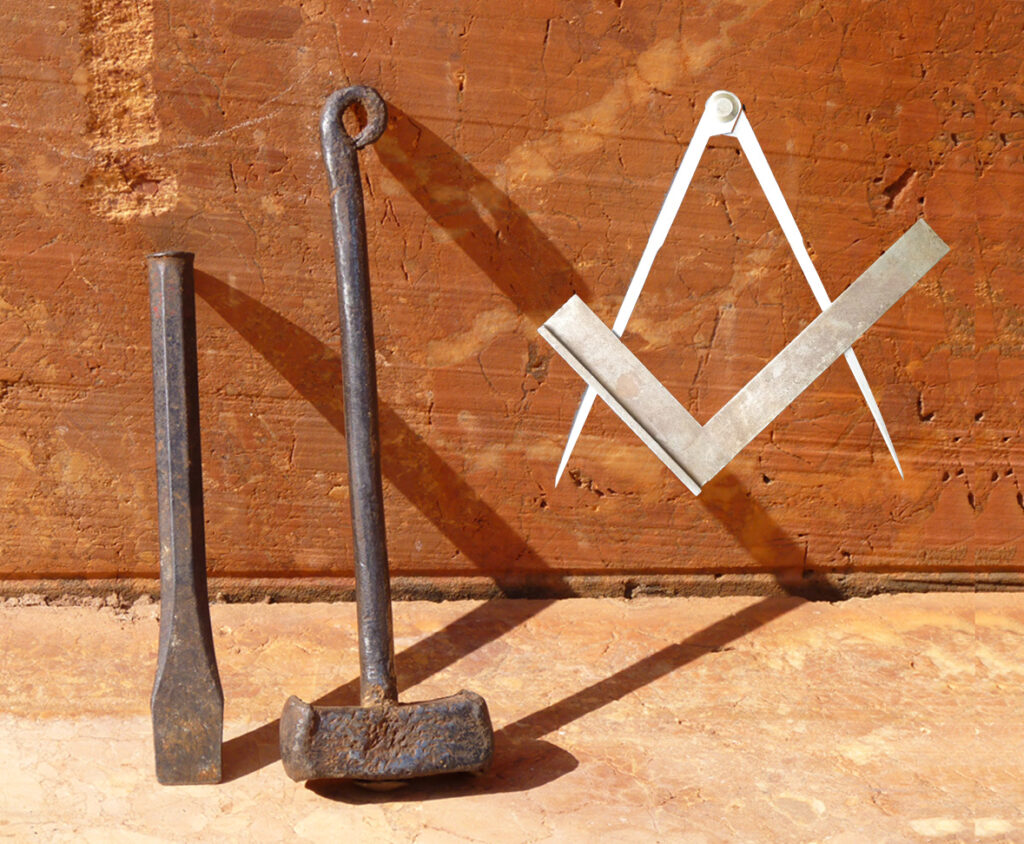
New Charges
1. In Anderson’s time, people were under such strong pressure from state and church authorities that expressing liberal ideas was dangerous. For this reason, many of these ideas appear only in concealed form within the Old Charges. Today, where freedom of expression is possible, it seems appropriate to state the meaning of the Old Charges openly and clearly.
2. As a result of the social developments that have taken place, many people have acquired new rights. However, new rights must be accompanied by new duties if a humane and dignified social order is to be preserved.
3. In the past, human beings were threatened primarily by the forces of the natural world around them. But as humanity learned to master the once‑hostile environment, human nature itself became the greatest danger to the survival of humankind.
To overcome these and other dangers, each of which on its own already threatens our survival, a prompt and profound change in the mentality of the people of our time is required. Freemasonry is called upon to contribute to this task, just as it did in the eighteenth century. Only if Freemasonry commits itself to these responsibilities will it once again be able to play the leading role in intellectual development that it once held. The ‘New Charges’ were established to prepare the Brotherhood for these new tasks..
I. SECTION I On God and Religion
Freemasonry is not a religious community; rather, it pursues exclusively secular goals. Religious belief should therefore remain a private matter for all brothers. You should therefore admit your new brothers into your lodges regardless of whether they profess belief in a personal God or not. You should also cooperate with other lodges as brother lodges, irrespective of whether they operate in the name of the ABaW or not. Today, ideological intolerance has often replaced religious orthodoxy. Since differing ideological views can divide humanity, it is the task of the lodges to facilitate understanding between adherents of different worldviews. The lodge has always fulfilled this task as a community for dialogue. Every brother has the right to engage in religious or political activities, but within the lodge, he has the duty to respect the honest opinion of his fellow brother; indeed, he should listen to this opinion at every opportunity and examine his own views in light of it. While religion and worldview are a private matter for the brethren, you should not be indifferent to the conclusions a person draws from their religion or ideology. Rather, you should consider whether these demands are in accordance with moral law, and you should extend your tolerance only to those who are themselves prepared to practice tolerance. Every Freemason should, however, profess the religion in which all people can agree: namely, the admiration of creation, reverence for life, and respect for the free individuality of humankind. From this it follows that you, as Freemasons, should investigate how the destruction of nature by humankind can be prevented and how the physical and spiritual well-being of humankind can best be promoted. With the ever-accelerating pace of social and technological development, the image of humanity is subject to constant change. Therefore, your foremost task in the lodge should remain the search for an answer to the question: “What must one be to be a human being?”
II. SECTION II On the Civil Authority, the Highest and the Subordinate (concerning the State)
Over the past two centuries, the principles of Freemasonry have been incorporated into the constitutions of numerous states. This demonstrates that Freemasons are conscious citizens who are committed to the well-being of their fellow citizens and feel a shared responsibility for all actions of the state. Freemasons are loyal to their state as long as it respects human dignity and rights. However, they reject any restrictions that hinder understanding among people. Many of the dangers facing humanity today can only be averted through global action. Therefore, Freemasons will advocate that, where necessary for the good of humanity, individual states should not insist on their absolute sovereignty, but rather delegate powers to higher, supranational organizations. Where a state deviates from respecting human rights and suppresses freedom of expression, the activities of lodges are usually prohibited and the members persecuted.
The work of Freemasons should therefore aim at the recognition of human rights in every community. These rights require a unique formulation in every age. Therefore, you should strive to continually redefine and uphold them. All Freemasons are obligated to support those who stand up for human rights and to alleviate the suffering of the persecuted. Many states no longer recognize a sovereign authority, but only representatives sent by free citizens to legislative assemblies. These representatives and the authorities serve the state and its citizens. The task of Freemasons is to make all citizens aware of their capacity for maturity and to promote its realization, so that they may exercise their rights wisely and fulfill their duties. These duties include, in particular, the constant critical examination of all state institutions in order to prevent their abuse.
SECTION III Off Lodges
The lodge is a community of discussion that grapples with the problems of its time. The purpose of this discussion is not to find absolute solutions, but to uncover the multifaceted roots of these problems so that everyone can address them in their own sphere of life with independent thought and responsible decisions. This aims to create spaces for freedom within an increasingly complex human society. In this respect, the lodge serves as a model of human society in which the individual learns to work within a group. The groups, in turn, learn how to collaborate within a larger framework without unduly restricting the rights of individual groups. If the lodge fulfills its mission, then the individual will gladly maintain discipline to further the tasks of the whole. If the Grand Lodge fulfills its mission, then the individual lodges will be prepared to delegate authority to the Grand Lodge to enable the execution of larger tasks. Since the lodge is a community of discussion, only brothers who are capable and willing to participate in dialogue should be admitted. This requires participants to have the goodwill to question their own thinking and overcome prejudices. Thus, the lodge helps individuals find themselves, and the work within the lodge, despite the required discipline, leads the brothers to a true spiritual freedom that is difficult for the individual to achieve alone. This spiritual freedom is incompatible with the ever-changing and historically conditioned relationships of recognition that have divided Freemasonry over the last two centuries. You should therefore regard as a brother everyone who professes the Old Charges of Anderson’s Constitutions. Likewise, you should not refuse cooperation with any lodge founded by seven brothers, including four Masters, that operates in accordance with the Old Charges. Since women in our time are increasingly assuming social responsibility and are no longer inferior to men in terms of education, some lodges have decided to admit women. This contradicts the wording of Anderson’s Constitutions: it is difficult to determine today to what extent the changing social structure justifies deviating from the principle that Freemasonry is a male-only organization. Therefore, you should carefully examine the experiences of mixed lodges and not refuse to cooperate with them. Under no circumstances should the question of admitting women become the cause of a further division within the Order.
SECTION IV Of the Civil Magistrate, Supreme and Subordinate
All power in the lodge emanates from the brothers.
The Master of the Lodge is the representative of the Lodge; his task is to enforce the Lodge’s will and oversee the execution of its resolutions. He distributes work within the Lodge to the brethren according to their abilities. He ensures the discipline within the Lodge that is necessary for the success of Freemasonry. All power in the Grand Lodge emanates from the Lodges. The Grand Master is the representative of the Grand Lodge; his task is to enforce the Grand Lodge’s will and oversee the execution of its resolutions. He is responsible for ensuring that the work in the individual Lodges meaningfully promotes the common edifice of Freemasonry. He assigns work to the Lodges, but only to the extent that this does not hinder the Lodge’s self-chosen projects. Who is the builder of Freemasonry? It is human society, to which all Freemasons feel obligated. Who is an Entered Apprentice? One who learns to recognize himself, his own abilities and limitations, in order to mature and work as a Fellow Craft within the group. Who is a Fellow Craft? He learns to work in a group in order to become capable of leading the work of a group as a Master. Who is a Master Craft? He contributes creatively to the work of the lodge. Thus, even as a Master Craft, you remain apprentices and Fellow Craft throughout your life, and the three degrees of Freemasonry are distinguished not by greater rights, but only by greater duties.
SECTION V Of the Management of the Craft in working
In the lodge, you should find respite from the pressures of daily life, allowing you to address the important questions of your time and your society with an open mind and in collaboration with your brothers. The protection afforded by the lodge allows you to express your views without regard for worldly constraints; the brotherhood will always be ready to consider your opinions. The self-knowledge and self-control demanded of you should enable you to participate in lodge work with discipline, for only when the hewn stones fit together well can a perfect structure be achieved. What do Freemasons work towards? They seek to build a edifice of humanity. They wish to understand what their time demands of them so that they may then act as spiritually free individuals in their secular lives. Your conduct in the lodge should be guided by the seriousness of this task. The venerable traditions of Freemasonry should be both your inspiration and your obligation. Thus, you should cultivate tradition, retain what has proven its worth, but not be hindered from working on the further development of Freemasonry. You should protect the ritual of Freemasonry from profanation, but constantly examine its meaning and significance and adapt it to the demands of your time. However, this should never break the chain of brothers who live with you and who have lived before you. No one is authorized to speak publicly on behalf of all Freemasonry. You may only speak publicly on behalf of individual lodges or grand lodges if the lodge or grand lodge has expressly authorized you to do so. As a rule, Freemasons do not influence the public as a lodge or grand lodge, but rather through the conduct of individual brothers.
SECTION VI Of Behaviour
Chapter VI and the conclusion of the Old Charges adequately address your conduct both within and outside the Lodge. We wish to add here only that throughout your life, your actions and omissions should be guided by the work of the Lodge, so that you may treat all brethren with brotherhood and all people with humanity.
.·.